
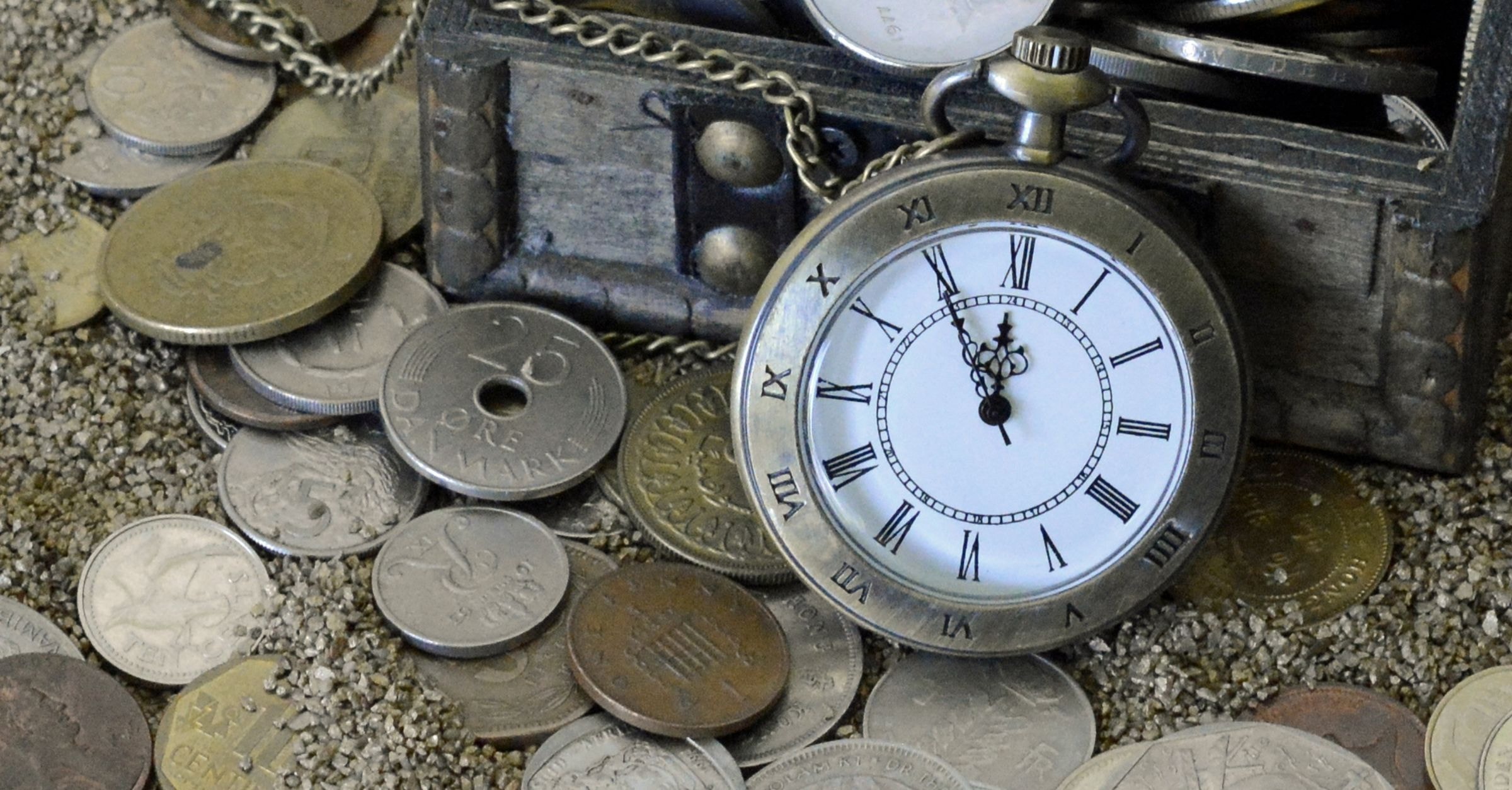
From the dawn of the monetary system, through its creation and evolution: understanding how we arrived at Bitcoin.
Every day, billions of transactions take place across the globe. Whether it is buying a coffee, paying for a service, or investing in the financial markets, money sits at the heart of our daily lives. Yet, despite this constant presence, few of us truly know its origin or the major milestones that shaped its evolution. In this article, you will discover the history of money, its crises, and the profound transformations that have driven it forward. Understanding how we transitioned from the earliest forms of credit to the emergence of Bitcoin also means gaining a clearer grasp of the stakes surrounding money today.
The Origins of Money
6th century BC: The first forms of money
Long before the appearance of coins or banknotes, exchanges took place without actual money. People often speak of barter, but this mode of exchange had a major limitation: the double coincidence of wants.
It required an exact match of needs between both parties. For instance, the person owning a hen had to need the apples you were offering. This type of situation made trade difficult and highly inefficient. In reality, within early human communities, exchanges were often based on trust.
For example, if a livestock farmer gave a cow to a neighbor, they did not necessarily receive something right away. They simply counted on the fact that this neighbor would return the equivalent later in wheat, tools, or services. It was a form of credit based on trust, without immediate exchange. However, as soon as exchanges took place between strangers or outside the village, trust was no longer enough. A medium of exchange accepted by everyone was required: money.
Certain goods, such as cattle, grain, salt, shells, or metal ingots, served as mediums of exchange. It was in this context that the first coins appeared in the 6th century BC in Lydia (modern-day Turkey). Made from precious metals and minted in standardized weights, they were far more practical as a medium of exchange.
16th - 17th century: Expansion of the use of precious metals
In the 16th and 17th centuries, gold and silver gradually became a monetary reference and a unit of account. Their scarcity, durability, and widespread acceptance made them reliable mediums for exchange. Many countries began basing their currency on these precious metals.
Money thus became a means of settlement and an instrument of immediate exchange. This mechanism reinforced confidence, as money relied on a tangible and universal reference.
19th century: A phase of prosperity, technological, economic, and social progress
In the second half of the 19th century, an economy backed by gold established lasting stability: the value of money experienced very little fluctuation. It was in this context that the gold standard was born: each currency unit corresponded to a precise quantity of gold held in reserve. This stability rested on a solid foundation-gold-which is difficult to produce in large quantities and impossible to manipulate. No one could create it ex nihilo to distort the market.
Because every banknote was convertible into gold, confidence in currency was reinforced. This climate of trust facilitated trade between countries, prices remained globally stable, and imbalances were rare. In the United Kingdom and America, prices even decreased slightly over a century (deflation) without slowing down the economy.
It was also in this context that English, German, and French economists debated the role of gold as a monetary foundation. France, for its part, even attempted to go further with the Latin Monetary Union (1865), a monetary unification based on gold and silver with Belgium, Italy, and Switzerland. Innovation advanced rapidly within a stable monetary framework where currency preserved its purchasing power.
The 19th century was marked by sustained growth, driven by innovation and long-term investments. This period witnessed significant economic, social, and technological breakthroughs, including the rise of railroads, electricity, modern chemistry, the internal combustion engine, and the early days of aviation. Much like today's electronics industry, where prices fall without dampening demand, the gold standard accompanied one of the most prosperous phases of modern history, notes Alexandre Stachtchenko.
The Monetary Order in the 20th Century: Crises and Evolutions
1914 - 1918: War financing and the beginning of inflation
At the outbreak of World War I, European countries suspended the convertibility of their currencies into gold. The gold standard, which constrained public spending, was incompatible with the demands of total war. This choice marked the first retreat of a monetary system built on discipline and scarcity. In 1914, the United Kingdom attempted to finance its war effort through traditional borrowing: high-yield bonds backed by appeals to patriotism.
The target was colossal-the equivalent of one year's GDP-but the fundraising ended in failure. Less than a third of the sum was collected, and from a very restricted pool of investors. Faced with this failure, the Bank of England resorted to an unprecedented method: creating money ex nihilo.
It granted loans to officials within the institution, who then used those funds to subscribe to the remaining bonds. The economist Keynes, who was in on the secret, called it a "masterful manipulation." Alexandre Stachtchenko emphasizes: "They simply invented money they didn't have."
This process made it possible to bypass taxation and traditional public debt. However, it also broke the implicit social contract of the gold standard: the banknotes and coins issued were no longer backed by actual gold. It is easy to print notes, but impossible to invent gold reserves. The direct consequence was a depreciation of the currency and the return of inflation. Allured by this "miracle solution," all the belligerent nations followed the same path.
Creating money without any apparent limit removed budgetary constraints, but at a heavy cost: a loss of monetary reference points, inflation, and the destabilization of economies. The United Kingdom attempted a return to the gold standard in the 1920s, but without lasting success. In Europe, Germany, the war's major loser, faced catastrophic hyperinflation. Its currency collapsed completely, the economy plummeted, and society was deeply destabilized. This episode marked a major rupture in monetary history.
1930s: Gradual abandonment of the gold standard
In the 1930s, the global economic crisis finished what the war had started: countries progressively abandoned the gold standard. The link between currency and a tangible asset was definitively broken. This opened the door to what Alexandre Stachtchenko calls "the century of inflation," where society's relationship with money was profoundly altered, and fiat currencies-completely detached from gold-lost all parity and became easier to manipulate.
1944: The Bretton Woods Agreements
Following World War II, the United States imposed a new global monetary order through the Bretton Woods agreements. Under this system, the US dollar became the only currency convertible into gold, establishing a new currency convertibility framework: all other currencies were pegged to the dollar, which itself was backed by gold. This granted immense power to the United States: controlling the currency at the heart of global trade, while committing to maintain a stock of gold equivalent to the dollars in circulation.
1945 – 1971: The drift of the system
Very quickly, American policymakers abused this dominant position. To finance costly social programs and sustain an interventionist foreign policy, they issued far more dollars than they held in gold reserves. By 1971, US reserves stood at 11 billion dollars in gold against 70 billion dollars circulating worldwide-more than six times the amount they were supposed to guarantee. Countries like France reacted and began demanding the conversion of their dollars into gold, even going so far as to send its navy to New York to retrieve its reserves. The monetary system was entering a crisis.
1971: The end of Bretton Woods and suspension of convertibility
Faced with a situation that had become untenable, President Richard Nixon suspended the convertibility of the US dollar into gold in August 1971. This move was felt as a betrayal of the international monetary system. The dollar immediately lost value, prices soared, and the first oil shock triggered shortly thereafter. This decision marked the end of the Bretton Woods system and the conclusion of the Post-WWII economic boom (Trente Glorieuses).
Since 1971: How does the monetary system work?
Since this break, the world has operated under a fiat currency regime: currencies that rely on nothing tangible. This opened the door to all forms of excesses: states can create money without limit to finance their spending, free from constraints or real anchoring. The result: structural inflation, a permanent loss of purchasing power, and growing pressure on savers; inflation has become the norm. No one seems ready to accept the sacrifices necessary to return to a healthy economy. The cost is therefore pushed onto future generations.
Bitcoin: A Response to the Instability of Monetary Systems in Crisis
2008: Global financial crisis and the creation of Bitcoin
In 2008, the collapse of Lehman Brothers investment bank triggered a global crisis, exposing the excesses of a system built on debt and unlimited money creation. Central banks responded by injecting massive amounts of liquidity, worsening inflation and the loss of purchasing power. It was in this context that Bitcoin was born, envisioned by Satoshi Nakamoto as a decentralized, scarce, and state-independent monetary alternative. The first block of the blockchain contained a clear message: The Times 03/Jan/2009 "Chancellor on brink of second bailout for banks." A powerful signal: Bitcoin was born as a direct reaction to the instability of the traditional monetary system.
2010s: First concrete use cases
In 2010, the first real-world Bitcoin transaction took place: a developer struck a deal with a pizza delivery driver and bought two pizzas for 10,000 BTC, a historic milestone now celebrated every year on May 22nd as Bitcoin Pizza Day. This marked the beginning of concrete usage and a fully digital currency without a central authority. At the time, Bitcoin primarily attracted cryptography enthusiasts, developers, tech-savvies, early investors, and people curious to test a new type of digital money.
Over the course of the 2010s, Bitcoin transitioned from a community experiment to a recognized exchange asset, and then to an alternative store of value, often compared to digital gold. In a world where fiat currencies regularly lose purchasing power, Bitcoin presented itself as a technological solution to a monetary drift perceived as systemic. Events such as the currency crises in Argentina, Venezuela, or Lebanon reinforced this image. For some, Bitcoin was becoming more than a speculative asset: it was a tool for financial sovereignty. Bitcoin is not a silver bullet, but rather a possible complement to existing monetary solutions.
2012: First halving
In 2012, the Bitcoin protocol experienced its first "halving": an automated event embedded in its code that cuts the block reward for miners in half. This reinforces its deflationary nature by marking a controlled slowdown in money issuance. The halving occurs every four years until the complete supply of 21 million BTC is issued.
2024 – 2025: The institutionalization of Bitcoin
Bitcoin entered a new phase: it became institutionalized. In 2024, several Bitcoin ETFs were approved, including BlackRock's, marking a symbolic turning point. Companies like MicroStrategy or The Blockchain Group hold Bitcoin on their balance sheets, viewing it as a strategic corporate asset. Subsequently, the US government, the world's leading economic power—following the election of President Donald Trump in 2024-officialized the creation of a strategic Bitcoin reserve using bitcoins seized by the state.
FAQ
What is the fundamental difference between barter, metallic money, and the current monetary system?
Barter relied on the direct coincidence of wants or on village credit relationships based on long-term trust. Metallic currencies (Lydia, 16th-19th centuries) introduced a universal, standardized, and scarce medium (gold, silver) whose value was tied to its physical tangibility. The current monetary system, born in 1971, uses so-called "fiat" money, disconnected from any physical asset. Its value relies exclusively on the trust placed in political and banking institutions, removing the discipline of material scarcity.
What did the 19th-century gold standard system consist of, and why was it abandoned?
The gold standard was a system where each currency unit issued by a central bank was convertible into a fixed and real quantity of physical gold held in its reserves. This model prohibited arbitrary money creation and guaranteed high price stability. It was suspended during World War I (1914) because the budgetary discipline it imposed prevented states from financing the war effort via the money printing press, thereby paving the way for an era of structural inflation.
What happened during the Bretton Woods agreements in 1944 and their breakdown in 1971?
In 1944, the Bretton Woods agreements established a global monetary order where only the US currency (the dollar) was directly convertible into gold by central banks. All other global currencies were pegged to the dollar. Between 1945 and 1971, the United States issued massive amounts of dollars to finance its spending without holding equivalent gold reserves. Faced with a crisis of confidence and demands for conversion (notably from France), President Richard Nixon unilaterally suspended the convertibility of the dollar into gold in August 1971, permanently shifting the world to a regime of floating, unbacked currencies.
Why is it said that Bitcoin was born as a direct reaction to the 2008 financial crisis?
The 2008 crisis, marked by the collapse of Lehman Brothers, brought to light the excesses of a banking system built on excessive leverage. To rescue the system, central banks injected massive amounts of liquidity (bank bailouts), which dilutes the value of money. Satoshi Nakamoto created Bitcoin in 2009 as a direct alternative to these interventions, etching into the network's very first block the headline from The Times newspaper reporting on the British Chancellor's second bank bailout, thereby marking an ideological and technical opposition to unlimited money creation.
What is the Bitcoin "halving" and why does it strengthen its comparison to gold?
The halving is a programmed and immutable computer event in Bitcoin's code that occurs every four years. It cuts in half the amount of new bitcoins distributed to the miners who secure the network. This mechanism strictly and predictably slows down the issuance rate of the asset, ensuring that the absolute limit of 21 million units will never be exceeded. It is this absolute mathematical scarcity and increasing difficulty of production that lead investors to refer to Bitcoin as "digital gold."